




If you've been receiving child support in Texas and heard about the 2026 income cap increase, you might be wondering why your monthly payments haven't changed. Here's the frustrating truth: your child support order didn't automatically adjust when the law changed. Even though Texas raised the income cap from $9,200 to $11,700 per month back in September 2025, your existing court order remains exactly the same, unless you take action.
This catches a lot of parents off guard. The law changed, your ex's income might justify a higher payment, but the checks stay the same. Why? Because in Texas, child support modifications aren't automatic. You have to file a formal petition with the court to see any increase, and that process involves specific legal requirements, strategic timing, and, let's be honest, a bit of patience.
At Tidwell Law Firm, PLLC, we've guided countless parents through child support modification in Collin County and across North Texas. Whether you're in Frisco, McKinney, Plano, or anywhere in the surrounding area, understanding how this process works can make the difference between leaving money on the table and securing the support your child actually needs. Let's break it down.
What Actually Changed in 2026 (And Why It Matters)
The Texas child support guidelines underwent a significant shift when the monthly net income cap increased to $11,700 effective September 1, 2025. For context, the previous cap sat at $9,200, meaning that only the first $9,200 of a paying parent's monthly net income was subject to the guideline percentages.
Here's why that matters: Texas calculates child support using a percentage-based system. For one child, that's typically 20% of the paying parent's net monthly resources. For two children, it's 25%, and so on. Under the old cap, even if someone earned $15,000 per month, child support was calculated on only $9,200 of that income. The new $11,700 cap expands the income base, potentially by quite a bit.
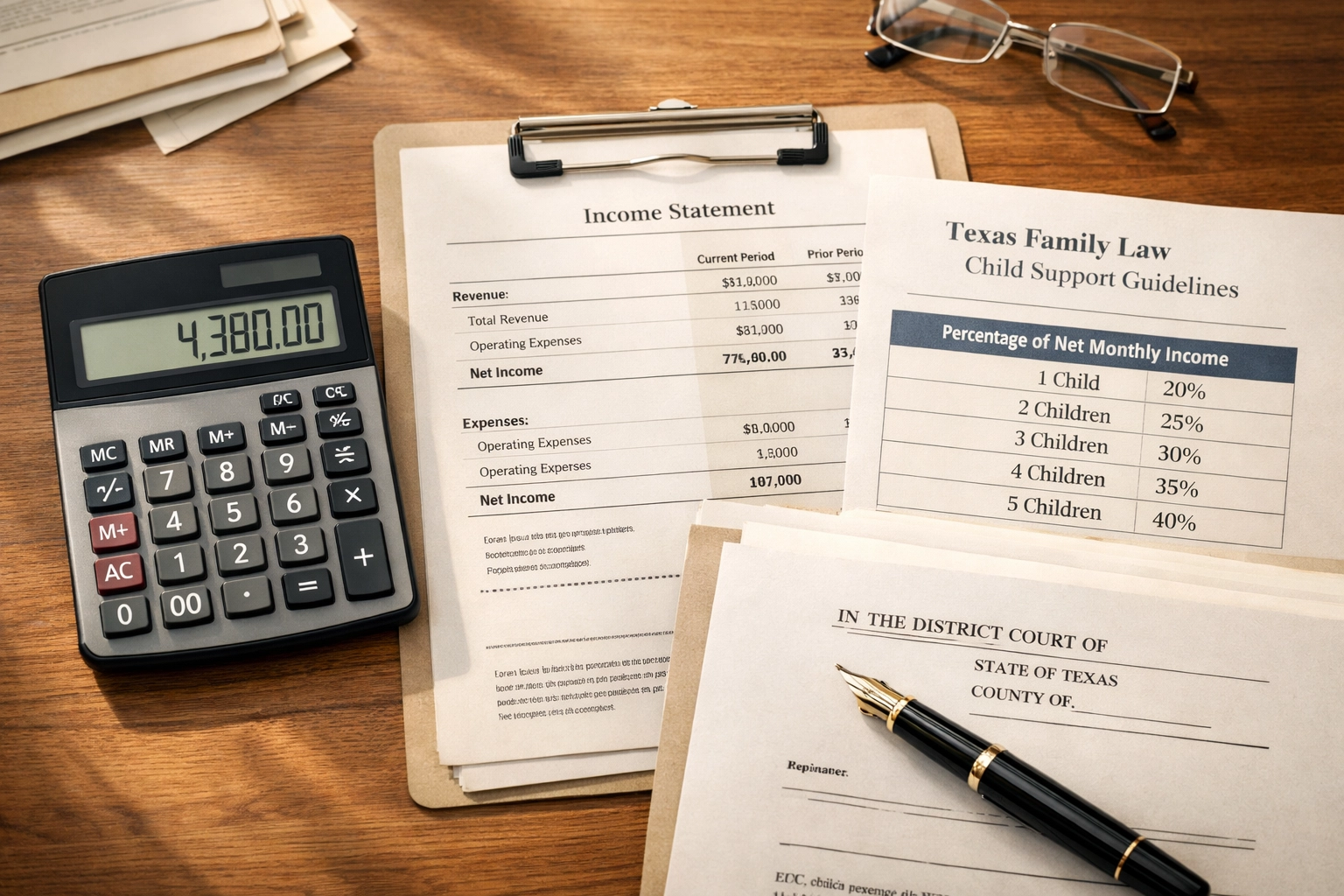
Example: Let's say your ex-spouse earns $12,000 per month in net income and you have one child together. Under the old $9,200 cap, guideline support would be 20% of $9,200, which equals $1,840 per month. Under the new $11,700 cap, that same calculation applies to the full $11,700, resulting in $2,340 per month. That's a $500 monthly difference, or $6,000 annually.
But here's the catch: if your divorce decree or child support order was finalized before September 2025, it's still based on the old cap. The court doesn't automatically recalculate and send you a new payment amount. You need to file a modification.
Why Modifications Aren't Automatic in Texas
Texas family courts operate on the principle that existing orders remain in effect until the court issues a new order. This means even beneficial changes in the law, like an increased income cap, don't trigger automatic adjustments to your case. There are good reasons for this approach, even if it feels frustrating in the moment.
First, not every case benefits from a modification. Some parents' incomes have decreased since the original order, others may have additional children that affect calculations, and some agreements included specific terms that deviate from guidelines for valid reasons. The courts want to ensure any change is fair, warranted, and in the child's best interest, and that requires a hearing where both parents can present their current circumstances.
Second, the legal system values finality and stability. Constantly reopening cases without proper cause would create chaos for families trying to plan their budgets and futures. By requiring formal petitions, Texas law ensures modifications happen only when there's a legitimate reason.
Do You Qualify for a Child Support Modification in Texas?
Not everyone can request a modification whenever they want. Texas law establishes specific eligibility criteria, and meeting at least one of these thresholds is essential before filing. Here are the three primary grounds for seeking a child support modification:
1. Three-Year Rule
If it's been at least three years since your current order was established or last modified, you can request a modification, period. You don't need to prove any other change in circumstances. This is the simplest path forward, especially if your existing order is aging and no longer reflects current realities.
2. Material and Substantial Change in Circumstances
Life changes. Maybe the paying parent got a significant raise, lost their job, or had another child. Perhaps your child's needs have increased due to medical expenses or education costs. If you can demonstrate a material and substantial change since the last order, the court may grant a modification even if three years haven't passed.
What counts as "material and substantial"? It varies, but examples include major income changes, remarriage, relocation, changes in custody arrangements, or significant shifts in the child's healthcare or education needs.
3. The 20% or $100 Rule
This is where the 2026 cap increase becomes particularly relevant. If applying the current child support guidelines would result in an amount that differs from the existing order by at least 20% or $100 per month (whichever is less), you qualify for modification.
Given the jump from a $9,200 cap to $11,700, many existing orders now meet this threshold automatically, especially for parents whose ex-spouses earn in the higher income ranges. Running the numbers is crucial here, and that's where working with an experienced attorney can save you time and frustration.
How to File a Child Support Modification in Collin County
Filing for a child support modification in Texas involves several steps, and getting it right the first time matters. Here's the general roadmap:
Step 1: Gather Your Financial Documentation
You'll need current financial information for both you and the paying parent (as much as you can obtain). This includes:
- Recent pay stubs or income tax returns
- Documentation of any income changes
- Records of the child's current expenses
- Any evidence supporting your grounds for modification
Step 2: File a Petition to Modify
You'll file a "Petition to Modify the Parent-Child Relationship" with the court that issued your original order. In Collin County, this typically means filing with the appropriate district court. Your petition must clearly state the legal grounds for modification and what specific changes you're requesting.

Step 3: Serve the Other Parent
Texas law requires that the other parent receive proper legal notice of your petition. This is typically done through a process server or certified mail, and you'll need proof of service filed with the court.
Step 4: Attend Court Hearings
Both parents will have the opportunity to present evidence and testimony about their current financial situations and circumstances. The judge will review the information, apply the current guidelines (including the new $11,700 cap), and determine whether modification is appropriate and what the new amount should be.
Step 5: Obtain a Modified Order
If the court grants your modification, you'll receive a new court order specifying the updated child support amount. This becomes the legally enforceable obligation going forward.
What to Expect During the Process
Let's be real: modifications take time. Even straightforward cases can take several months from filing to final order, and contested modifications where both parents disagree can stretch longer. The courts in Collin County handle heavy dockets, and family law cases require thorough review.
You should also expect the paying parent to potentially resist the modification, especially if it means higher payments. They may present evidence of decreased income, claim additional exemptions, or argue that the increase isn't justified. Having solid documentation and legal representation helps counter these challenges effectively.
Remember that the court's primary focus is always the best interest of the child. Judges want to ensure children receive adequate financial support while also being fair to both parents' circumstances. Approaching the process with this mindset, rather than viewing it as purely adversarial, often leads to better outcomes.
At Tidwell Law Firm, PLLC, we handle child support modifications regularly and understand the nuances of how Collin County courts approach these cases. Our team can help you calculate whether the new cap justifies modification in your situation, gather the necessary documentation, and present a compelling case to the court.
Common Mistakes to Avoid
Waiting Too Long
The longer you wait after becoming eligible, the more support you potentially leave on the table. Modifications typically aren't retroactive, they take effect from the date you file or the date of the court's order, not from when the cap changed.
Filing Without Proper Grounds
Jumping the gun and filing before you meet one of the eligibility criteria can result in your case being dismissed. Make sure you qualify first.
Failing to Document Everything
"He makes more now" isn't enough. You need actual evidence, pay stubs, tax returns, employment records. Gather comprehensive documentation before filing.
Going It Alone on Complex Cases
If your situation involves high incomes, self-employment, stock options, or other complicated financial arrangements, trying to navigate modification without an attorney often backfires. The other side will likely have representation, and you don't want to be outmatched.
FAQ About Texas Child Support Modifications
Does the paying parent get notified about the cap increase?
The Office of the Attorney General may send informational notices, but there's no requirement for automatic notification. It's your responsibility to initiate modification if you want the new cap applied.
Can the paying parent also request a modification?
Absolutely. Either parent can petition for modification if they meet the eligibility criteria. Sometimes paying parents seek reductions based on decreased income or changed circumstances.
Will modification affect other parts of my divorce decree?
No. A child support modification typically only changes the support amount. Custody, visitation, and other terms remain unchanged unless you separately petition to modify those as well.
How much does filing for modification cost?
Court filing fees in Texas vary by county but typically run a few hundred dollars. Attorney fees depend on case complexity. Many firms, including Tidwell Law Firm, offer consultations to discuss your specific situation and potential costs.
What if my ex is self-employed or hiding income?
This complicates matters but doesn't make modification impossible. Your attorney can subpoena financial records, hire forensic accountants, and use discovery tools to uncover accurate income information.
Take the Next Step
The 2026 child support cap increase represents a real opportunity for many Texas parents to secure more appropriate support for their children. But that opportunity only becomes reality if you take action. Don't assume the system will update your order automatically: it won't.
If your child support order predates September 2025 and your ex-spouse earns in the higher income ranges, running the numbers is worth your time. You might be entitled to significantly more support than you're currently receiving, and every month you wait is another month of potential support left uncollected.
At Tidwell Law Firm, PLLC, we help parents throughout Collin County navigate child support modification in Texas with clarity and confidence. We'll review your current order, calculate whether modification makes sense under the new cap, and guide you through every step of the process.
Your child deserves adequate financial support, and you deserve straightforward answers about your legal options. Contact us today to discuss your situation and learn how we can help you pursue the modification you need.