




If you're on probation in Collin County and just caught a new felony charge, you're facing one of the most precarious situations in the Texas criminal justice system. This isn't just another setback, it's a legal firestorm that could result in serving time for both your original offense and the new charge. The stakes are incredibly high, but understanding what you're up against is the first step toward protecting your freedom.
At Tidwell Law Firm, PLLC, we've guided countless clients through probation revocation proceedings in McKinney, Frisco, Prosper, and throughout Collin County. We know how overwhelming this moment feels. Let's break down exactly what happens when you catch a new felony charge while on probation and why immediate legal representation isn't optional, it's essential.
Understanding "New Law Violations" in Texas Probation
When you're placed on probation in Texas, you're given a conditional release with strict terms. Violating those terms falls into two distinct categories: technical violations and new law violations. A new felony charge represents the most serious type of probation violation, what courts and prosecutors refer to as a "substantive violation."
Technical violations might include missing a meeting with your probation officer, failing a drug test, or not completing community service hours. While serious, these violations show you broke the rules of probation itself. A new law violation, however, means you've allegedly committed an entirely separate crime while still serving probation for your original offense.
This distinction matters enormously. Technical violations can sometimes be addressed with additional probation conditions or short jail sanctions. A new felony charge? That opens the door for your probation to be completely revoked, sending you to serve your original sentence, plus facing prosecution for the new crime.
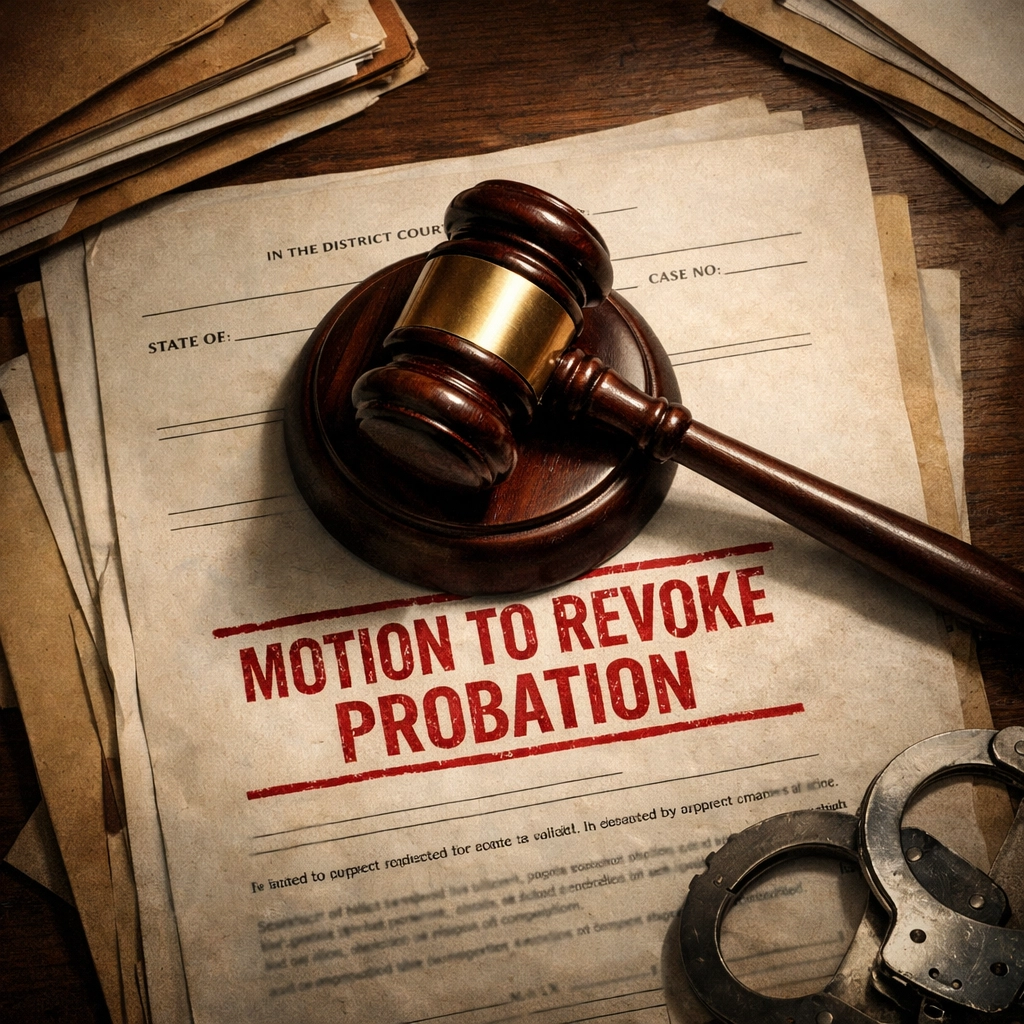
The Motion to Revoke (MTR) Process
Once the State becomes aware of your new felony charge, the district attorney's office will typically file a Motion to Revoke Probation (MTR) or a Motion to Adjudicate Guilt if you were on deferred adjudication. This legal filing formally asks the court to revoke your probationary status and impose a prison sentence for your original conviction.
Here's what happens next in Collin County courts:
- Warrant Issued: A warrant for your arrest is often issued immediately following the MTR filing
- Detention: You may be held without bond on the probation violation, even if you post bond on the new charge
- Revocation Hearing: A hearing is scheduled where the State must prove you violated probation terms
- Judge's Decision: The judge, not a jury, determines whether to revoke your probation and what sentence to impose
Unlike your original criminal trial, you have significantly fewer protections during a probation revocation hearing. The rules of evidence are more relaxed, the burden of proof is lower, and you have no constitutional right to a jury trial for the revocation itself.
Technical Violations vs. New Law Violations: Why It Matters
Understanding the difference between these two violation types is crucial for your defense strategy:
Technical Violations
- Missing appointments with your probation officer
- Failing to pay fines or restitution on schedule
- Positive drug or alcohol tests
- Traveling outside your approved area without permission
- Failing to complete required classes or community service
New Law Violations
- Being arrested for any new criminal offense (misdemeanor or felony)
- Being charged with a new felony while on probation
- Receiving a conviction for conduct that occurred during your probation period
The State views new law violations, especially new felonies, as evidence that probation has completely failed as a rehabilitative tool. It signals to the court that you're not taking your second chance seriously and pose a continued threat to public safety. Prosecutors push harder for full revocation in these cases, and judges are far less sympathetic than they might be with a technical slip-up.
The Dual Jeopardy: Fighting Two Cases at Once
When you catch a new felony charge while on probation, you're suddenly navigating two parallel legal proceedings:
Case #1: The New Felony Charge
This case proceeds through the normal criminal justice system. You're entitled to all constitutional protections: the presumption of innocence, proof beyond a reasonable doubt, right to a jury trial, and full discovery rights. The State must build a case and prove you committed the alleged new offense.
Case #2: The Motion to Revoke
This proceeding focuses on whether you violated your probation terms. The burden of proof is drastically lower, the State only needs to show by a "preponderance of the evidence" (essentially, more likely than not) that you violated conditions of your probation. That's roughly 51% certainty versus the 99%+ certainty required in criminal trials.
Here's the trap: even if you're ultimately acquitted of the new felony charge, the State can still use that arrest and the circumstances surrounding it to revoke your probation. The mere fact that you were arrested, charged, and allegedly engaged in criminal conduct can be sufficient evidence to meet the lower standard in revocation proceedings.
Consequences of Probation Revocation in 2026
If the court grants the State's Motion to Revoke, the consequences are severe and permanent:
Immediate Incarceration
The judge can sentence you to serve the original sentence that was suspended when you were granted probation. For example, if you were facing 10 years for aggravated assault but received probation instead, the court can now impose that full 10-year sentence, or any portion of it up to the maximum.
Stacked Sentencing
After serving time for the original offense, you'll then face trial and potential sentencing for the new felony charge. Depending on the circumstances, you could be looking at consecutive sentences that stack on top of each other.
Loss of Future Probation Eligibility
Probation revocation creates a permanent black mark on your criminal record. If you're convicted of future offenses, judges will be extremely reluctant to grant probation again. You may be statutorily ineligible for probation in certain subsequent cases.
No "Do-Overs"
Unlike some court orders that can be modified or appealed successfully, probation revocation is typically final. Once your probation is revoked and you're sentenced to prison, there's no going back to probationary status. This permanence makes aggressive, skilled defense representation absolutely critical from day one.
Why the Burden of Proof Puts You at Risk
One of the most dangerous aspects of probation revocation proceedings is the dramatically lower burden of proof. In your original criminal trial, the State had to prove guilt "beyond a reasonable doubt", the highest standard in American law. That standard exists to protect innocent people from wrongful conviction.
In a revocation hearing, however, the State only needs to prove a violation by a preponderance of the evidence. This means if the judge believes it's 51% likely that you violated probation, that's enough to revoke and send you to prison.
Consider this scenario: You're on probation and get into an altercation at a Frisco bar. Police arrest you for assault. At your criminal trial for the assault charge, your attorney successfully argues reasonable doubt, maybe the "victim" was the aggressor, maybe witnesses contradict each other, maybe surveillance footage is inconclusive. You're acquitted.
But at your probation revocation hearing? The State only needs to show it's more likely than not that you engaged in assaultive behavior that night. The same evidence that created reasonable doubt at trial might be enough to meet the lower standard at the revocation hearing. You walk free from the new charge but go to prison anyway for violating probation.
This disparity is why many criminal defense attorneys consider probation revocations some of the most challenging cases to defend.
Why You Need Aggressive Representation in 2026
The landscape of criminal defense in Collin County has evolved significantly. Prosecutors are more sophisticated, courts are managing heavier dockets, and the stakes for defendants have never been higher. If you're facing a new felony charge while on probation, here's why you need experienced legal counsel immediately:
Strategic Coordination Between Both Cases
Your attorney needs to carefully coordinate defense strategies for both your new charge and your revocation hearing. Statements made in one case can impact the other. Evidence gathered for one proceeding might be admissible in the other. A skilled attorney manages these moving parts to avoid inadvertently damaging your defense.
Negotiation Leverage
An experienced probation violation attorney knows how to negotiate with prosecutors and probation officers. Sometimes it's possible to work out agreements where you receive modified probation terms rather than full revocation, especially if the new charge is ultimately dismissed or reduced.
Challenging the State's Evidence
Even with the lower burden of proof, the State still must present evidence. Your attorney can challenge the reliability, relevance, and admissibility of that evidence. We can cross-examine witnesses, present contradictory evidence, and argue that the State hasn't met even the preponderance standard.
Presenting Mitigating Circumstances
If revocation seems likely, your attorney can present evidence of mitigating circumstances: steps you've taken toward rehabilitation, family hardships, employment considerations, or other factors that might convince the judge to impose a lighter sentence than the maximum.
At Tidwell Law Firm, PLLC, we've successfully defended clients in complex probation revocation cases throughout McKinney, Frisco, and Prosper. We understand Collin County courts, we know the local prosecutors, and we fight relentlessly to protect our clients' freedom.
Frequently Asked Questions
Can I be held without bond on a probation violation?
Yes. While you may be eligible for bond on the new criminal charge, judges often deny bond on the Motion to Revoke itself. This means you could remain in custody even after posting bond for the new offense.
What if I'm innocent of the new charge?
Even if you're ultimately found not guilty of the new felony, the arrest and circumstances can still support probation revocation under the lower burden of proof. Your attorney must fight both cases simultaneously and strategically.
Can probation be revoked for a misdemeanor, or only felonies?
Technically, any new criminal offense: including misdemeanors: can violate probation terms and trigger a Motion to Revoke. However, prosecutors are more aggressive about pursuing revocation for felony charges.
How long do I have to fight a Motion to Revoke?
There's no statute of limitations on probation violations that occur during your probationary period. However, once the State files an MTR, your revocation hearing typically occurs within weeks or a few months, depending on court schedules and case complexity.
What's the difference between regular probation and deferred adjudication?
With regular probation, you're convicted but your sentence is suspended. With deferred adjudication, no conviction is entered if you successfully complete probation. However, if you violate either type, the consequences are similarly severe: the judge can impose the original sentence.
Take Action Now to Protect Your Future
Facing a new felony charge while on probation is a crisis that demands immediate, strategic legal action. Every day that passes without experienced representation is a day the State builds its case against you on both fronts. The consequences of inaction: years in prison, loss of career opportunities, permanent criminal records: are too severe to navigate alone.
The attorneys at Tidwell Law Firm, PLLC have dedicated their careers to defending clients in Collin County's toughest criminal cases. We know the judges, we understand the prosecutors' strategies, and we've successfully guided clients through the probation revocation process countless times. More importantly, we understand the fear and uncertainty you're experiencing right now.
Your freedom is worth fighting for: but the fight begins now, not later. Contact us today for a confidential consultation about your case. We'll review your situation, explain your options in plain English, and start building a defense strategy designed to protect your freedom and your future.
This isn't the end of your story. With the right legal team in your corner, it's possible to navigate even the most challenging probation violation cases. Let us help you fight back.